
By Damian Mathews & The Last Mile Team
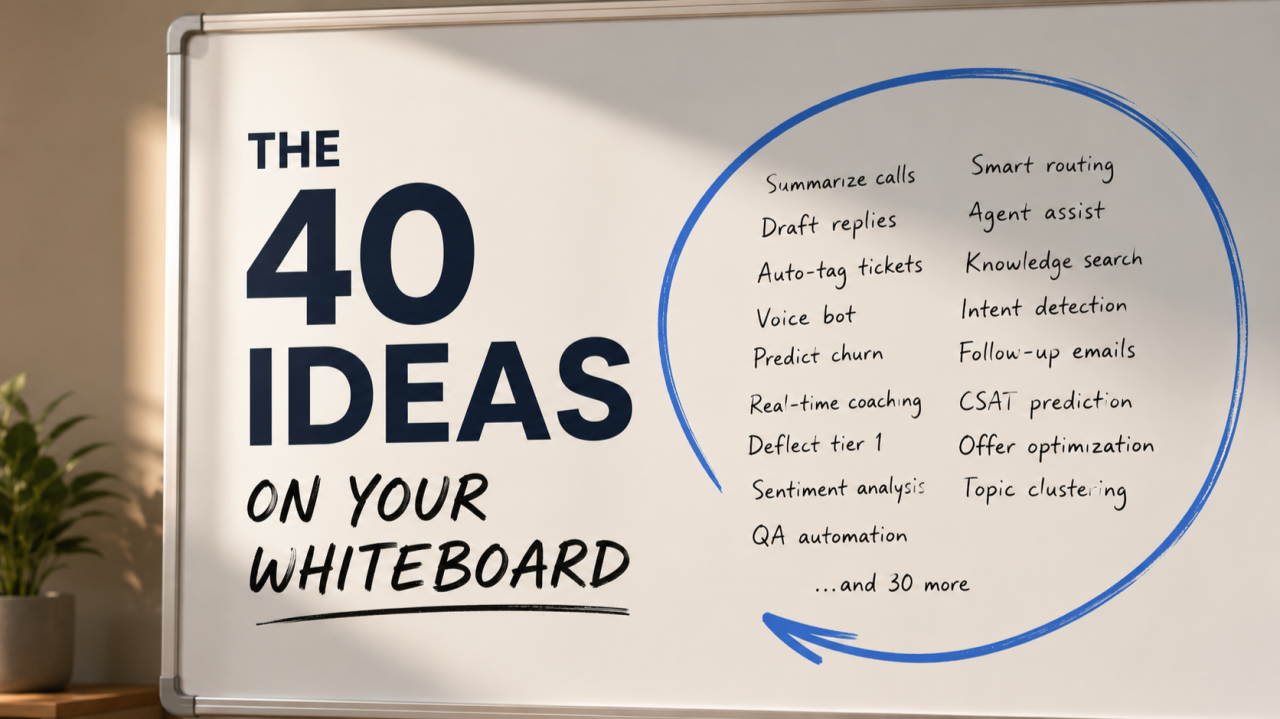
Somewhere in your building there’s a whiteboard, a Miro board, or a slide with a long list of AI ideas on it. Summarize calls. Draft agent replies. Auto-tag tickets. Stand up a voice bot. Predict churn. Coach agents in real time. Deflect tier 1. The list keeps growing because every vendor demo and every LinkedIn post adds another line to it.
The question nobody in the room can answer is which one to do first.
This is the most common place we see CX teams stall. Not on whether to use AI. On where to point it. And the way most organizations break the tie is usually the thing that gets them in trouble later.
Some pick by excitement. The flashiest demo wins, usually the real-time voice agent, because it’s the one that makes the room lean forward. Some pick by mandate. An executive saw something at a conference and now that’s the priority. Some pick by pain, chasing whatever annoys leadership most, whether or not it’s common or solvable.
None of those are evidence. They’re guesses dressed up as strategy, and they’re why so many pilots launch with real energy and quietly die six months later.
The better starting point is already sitting in a system you own. Your conversations.
Every call, chat, and ticket your team handles is a record of what your customers actually need, how often they need it, and where your current process breaks down. Most use case lists get built from what people imagine customers want. The useful list gets built from what the conversations show is really happening. So the first move isn’t generating more ideas. It’s reading the evidence you already have.
There’s a version of this you can run yourself, today, without us in the room. Take the 40 and map them on two axes: volume and complexity. The high-volume, low-complexity use cases are where you start. They have enough scale to matter and few enough moving parts to get right, which is exactly what earns the early win. That one exercise clears most of the board.
The next layer sharpens it. Once you’re working from real conversation data, the filter we use comes straight from our own AI transformation, documented in A1B: Customer Zero to AI-First. Kerry calls it Possible, Practical, Profitable.
Possible asks whether AI can reliably do this today. Not in a demo, but in the messy reality of your contacts, with your edge cases and your customers. Practical asks whether it can do it inside your actual environment: your systems, your data access, your compliance constraints, your integrations. Plenty of things that are possible in principle fall apart in your stack. Profitable asks whether it’s worth doing at all, meaning enough volume, enough value, or enough cost-to-serve that fixing it moves something real.
A use case has to clear all three. Most of the 40 ideas on the whiteboard clear one, maybe two.
There’s one more lens we always add, because it’s where teams get burned. For every candidate, look at what happens when the AI gets it wrong. An AI that mis-summarizes a closed ticket costs you a little cleanup. An AI that gives a customer the wrong billing information makes a promise you now have to honor. Same technology, very different blast radius.
The strongest place to start is the overlap of all of it. High volume, genuinely suited to today’s AI, and forgiving when it fails. In a lot of contact centers that turns out to be something unglamorous like order and delivery status, which can be a third of inbound volume, sits well within what AI handles reliably, and does little harm if it occasionally has to hand off to a human. It’s rarely the flashiest item on the board. It’s usually the one that earns the proof and the internal confidence you’ll need before going anywhere near the high-stakes work.
This is the whole reason CX Foundry starts with a snapshot of your real conversations instead of a workshop of ideas. The conversations rank the candidates. Possible, Practical, Profitable narrows the field. The blast-radius question picks the entry point. By the time anyone is building, they’re building the thing the evidence chose, not the thing that won the meeting.
The 40 ideas were never the problem. The missing piece is a way to rank them, and that ranking isn’t really a matter of opinion. It’s sitting in the conversations you’re already having every day.
When you look at your own AI list, do you know which one your customers would put first?
— Damian
Here’s what went down this week.
Bleeding Edge
Early signals you should keep on your radar.
China is drafting a $295 billion plan to wire the country with AI data centers. Reports say it would require 80% domestic hardware, leaning on Huawei and largely shutting Nvidia out of the buildout. If Beijing hits its 2028 target, the move may harden a split compute market where Western and Chinese AI run on entirely separate silicon.
Google started rolling out Gemini 2.5 Deep Think, a parallel-reasoning mode for its Pro model. It pairs a two-million-token context window with multi-path reasoning that Google says leads current science and math benchmarks. Leaderboard wins rarely survive real workloads, but a model that can hold an entire codebase in context looks like genuine pressure on rivals.
Leading Edge
Proven moves you can copy today.
An OpenAI model ran a real wet-lab chemistry loop with startup Molecule.one and cracked a stubborn reaction. Across 10,080 experiments, GPT-5.4 raised mean yields on a sulfonamide coupling from 16.6% to 25.2%, with chemists checking every step. The result is narrow and still human-supervised, yet R&D leaders should watch how quickly ‘human in the loop’ slides toward ‘human on the loop.’
Assort Health raised $120 million to scale AI that answers patients’ phone calls. The Series C values it near $1.2 billion as voice agents now handle much of the inbound scheduling at some US hospitals. For any contact center the lesson is plain: where calls are repetitive and staffing is thin, voice automation finally appears ready to earn its keep.
Off the Ledge
Hype and headaches we’re steering clear of.
Anthropic’s Fable 5 and Mythos 5 are still dark two weeks after a US export-control order pulled them. Reporting suggests a ‘fix this code’ prompt set it off, and cybersecurity researchers have signed a letter calling the ban dangerous. Washington can apparently switch off a deployed frontier model overnight, a precedent that may rattle any enterprise pinning its roadmap to one vendor’s API.
Tech layoffs are running near 1,115 jobs a day in 2026, and many employers are pointing at AI. Analysts flag a wave of ‘AI washing,’ where cuts driven by overhiring or soft revenue get repackaged as automation gains. Pinning it on the robots writes a clean press release, but boards may eventually ask where all that promised productivity actually went.
